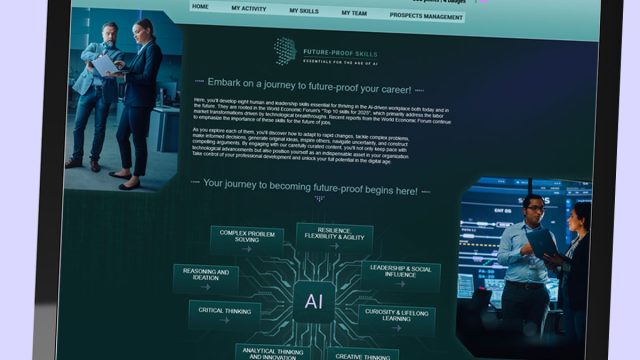
Skill Activation: soft skills content and practice, finally in the same place
Until now, soft skills training made you pick: learn from content, or practice in a role-play. Never both in one place.
Skill Activation changes that. Every path takes learners from an expert’s method straight into a real conversation with an AI avatar. The soft skills market hasn’t seen this format before.
How Skill Activation compares
| Skill Activation | E-learning library | Classroom | AI avatars | |
|---|---|---|---|---|
| Expert content and practice in the same path | Yes | No | Yes | Sometimes |
| Realistic conversation practice | Yes | No | Yes | Yes |
| Available to every learner | Yes | Yes | No | Yes |
| Practice in private, as often as you like | Yes | No | No | Yes |
| Practice based on an expert’s method | Yes | Sometimes | Sometimes | Sometimes |
| Ready to use, nothing to build | Yes | Sometimes | Sometimes | Sometimes |
Inside a Skill Activation path
Every path follows CrossKnowledge’s own learning method, built on more than 25 years of learning design. The same steps guide your learners from “I know how to do it” to “I’m confident doing it at work.”
- Introduction
why the skill matters, what learners get out of it and how the path is organized. - Discover the skill
a quiz or short scenario video, then an article or interactive piece that defines the skill. - Learn the theory
expert videos and articles, with prompts to think about how the theory applies at work. - Practice with an AI avatar
Learners talk it through with the avatar, acting as a trainer or a coach, and get feedback after each attempt. They can go again as often as they like, then leave with an action tip or plan. - Wrap up and reflect
Key takeaways, extra resources and a short survey to close the path.
It’s like having a buddy and a coach available anytime, anywhere.
Afia Tak, Global Learning Innovation & Infrastructure Manager, Alstom
15,000+ people managers
63 countries
15 languages
Skill Activation is new, but the idea behind it has been running at Alstom for a while. Their managers learn the theory of feedback first, then practice it with avatars, which is how every Skill Activation path works.
Three ways to practice with AI avatars
Each path uses at least two of them, depending on the skill.

Rehearse a set scenario
The scenario is written to match the path, so the conversation tests exactly what the learner has just studied.
_

Rehearse your own case
The learner describes something from work, say a late report or a tricky salary talk, and practices that exact conversation.
_

Think it through
There’s no scenario here. The coach asks questions until the learner knows how they’ll use the skill in their own job.
_
Premium soft skills content first, then practice that follows it
Each path uses at least two of them, depending on the skill.
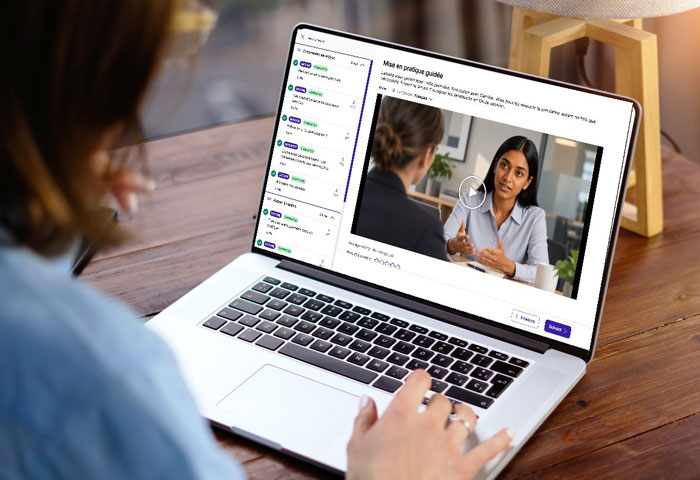
The avatar doesn’t make up its own advice. Every conversation comes after a path based on the work of a CrossKnowledge Faculty expert, and we review each scenario so the feedback matches what the path teaches.
Experts include Dorie Clark, Michel Ghazal, Ed Lawler and Matthieu Ricard.
- 45 min at most per path
- Mobile: phone, tablet or laptop
- EN and FR: content and avatars
Some of the experts behind Skill Activation

Dorie Clark
Career strategist and author of Reinventing You and The Long Game. Expert on career growth and personal branding.

Mathieu Ricard
Buddhist monk with a PhD in molecular genetics, author of books on happiness, altruism and compassion.

Ed Lawler
Founder of USC’s Center for Effective Organizations. Expert on motivation, rewards and high-performance organizations.

Marie R. Miyashiro
Nonviolent Communication practitioner and author of The Empathy Factor, on bringing empathy into the workplace.

Didier Noyé
Management and HR development consultant, author of practical guides on feedback, conflict and team leadership.
What changes when people practice first
For L&D Teams
You can offer role-play to every manager without booking a trainer or a room.
It runs in your CrossKnowledge platform, or in your own LMS through SCORM.
Learner conversations are never used to train AI models, usually the first thing IT and legal ask about.
For your learners
They can rehearse a performance review or a negotiation before it happens.
They practice alone, and as many times as they want.
They walk into the real conversation knowing what they want to say.
+275% more confident to act on what they’d learned, for people who practiced in VR simulations compared with a classroom group.
Source: PwC, VR Soft Skills Training Efficacy Study, 2020
Workplace conversations to practice
For team leaders
Conduct successful performance reviews
Practice giving performance feedback to a team member, so the review ends with a clear direction. Based on Jean-Luc Chaouch’s research.
Give constructive feedback
Practice feedback a team member can hear and act on, without it turning into a defense. Based on Didier Noyé’s work.
Manage challenging conversations
Use Nonviolent Communication to keep a tense exchange with a team member on track. Based on Marie R. Miyashiro’s work.
Resolve tension
Learn how people react under pressure, then practice calming a conflict with a team member. Based on Matthieu Ricard’s work.
Motivate and support your staff
Practice a conversation about what keeps a team member motivated, and what doesn’t. Bring a real case and practice setting clear expectations with your team.
For every employee
Develop your self-esteem in work relationships
Practice taking criticism from a colleague without taking it personally. Based on Marie-Joseph Chalvin’s work.
Dream up your own career path
Rehearse the career conversation you’ve been meaning to have with your manager. Based on Dorie Clark’s work.
Leverage the Mutual Gains Approach
Negotiate with a key vendor and look for a deal that works for both sides. Based on Michel Ghazal’s work.
Plan your work effectively
Talk a colleague through competing priorities and agree on what comes first. Based on Dominique Chalvin’s work.
Questions about Skill Activation
How does Skill Activation compare to other learning content?
Most digital learning content explains a skill: learners read or watch, and practice happens later, if at all. Skill Activation paths go one step further. They’re built on the work of the CrossKnowledge Faculty, follow CrossKnowledge’s own learning method, and include spoken practice with an AI avatar, with feedback, so learners rehearse the skill before they use it at work.
How much does Skill Activation cost?
The price depends on four things: how many paths you choose, how many learners you want to train, where you deploy it (your CrossKnowledge platform or an external platform such as your own LMS) and the length of your subscription, one or two years. Book a demo or contact your account team for a quote.
What happens to what learners say to the avatar?
It stays private. Conversations are never used to train OpenAI, Microsoft or any other company’s models, and other clients can’t see them. Colleagues and managers can’t either. Skill Activation runs on Microsoft Azure OpenAI, with data stored in Germany and the Netherlands.
Do learners speak or type with the AI avatar?
They speak. The avatar listens and replies out loud, and what it says depends on what the learner said.
How do we deploy Skill Activation?
In your CrossKnowledge platform, or in your own LMS through SCORM. If you don’t have an LMS, we can host it for you.
How is it different from CrossKnowledge Avatar?
CrossKnowledge Avatar is the technology you use to build practice into your own programs, as Alstom did. Skill Activation is a ready-made soft skills collection, with premium content and the avatar practice already designed together.
Can we adapt the scenarios to our company?
The paths are ready to use as they are. If you want your own terminology, situations or a custom path, our learning designers can build it as a separate project with CrossKnowledge Avatar.
Try a conversation with an avatar
Book 30 minutes with our Account Executive. You’ll do a practice session yourself, and we’ll look at where it could fit in your programs.
Already a client? Contact your account team to add Skill Activation to your platform.